

We are in FULL Holiday mode and for me, it can be overwhelming…
There’s a familiar tightness that creeps in when a “yes” wants to escape your lips, even though your body is already signaling “no.” Perhaps it’s an invitation that feels overwhelming, a favor requested during a week when your bandwidth is already stretched thin or a conversation that subtly crosses a line.
The discomfort isn’t just about the request itself; it’s also the fear that saying no will make you seem cold, harsh or unavailable. It feels as if you’ve turned into someone others need to tiptoe around.
However, setting a boundary is often not about pushing people away; it’s about maintaining a margin in your life so you don’t burn out.
Here’s what this has looked like in practice:
1. The Pause That Prevents the Spiral
There’s often a split-second window before the automatic “sure” response kicks in. That’s the moment that truly matters, and I’ve started to recognize it.
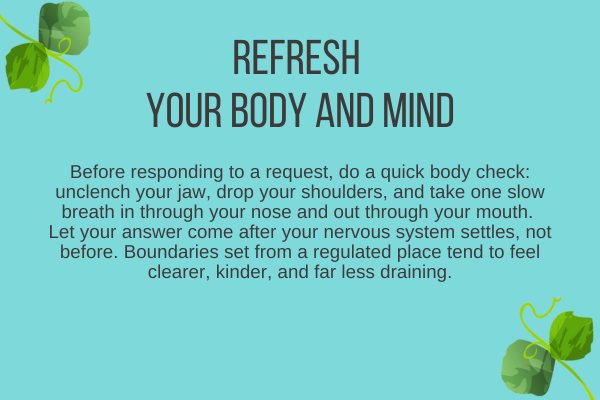
Sometimes, I place my hand on the back of my neck, where tension tends to gather. Other times, I simply take a small breath and say, “Let me check my week first.” This buys me time, softens the sense of urgency and allows me to respond from a place of grounding rather than reactivity.
What I’ve observed is that when I pause, I usually already know what I need. I just needed permission to listen to myself.
2. Language That Doesn’t Abandon You
Saying no doesn’t have to be harsh; it can be calm and steady. I’ve learned to use words that reflect the energy I’m trying to protect.
“I’m at capacity that day, but I hope it goes wonderfully.”
“I want to be honest that I’m not available to give this the attention it deserves.”
“I care about this, which is why I need to decline for now.”
None of these are scripts; they’re touch points. They help me communicate from a place of alignment rather than guilt.
3. Letting the Boundary Be Boring
Some boundaries aren’t dramatic; they don’t stem from betrayal or conflict.
Instead, they’re quiet decisions you make for your well-being: leaving an event early because you feel overwhelmed, putting your phone in another room after dinner to give your eyes a break, or unsubscribing from group texts that keep you constantly replying.
These choices are not about something being wrong. They are designed to help your nervous system function more effectively.
3. Expecting the Discomfort (But Not Interpreting It)
Feeling discomfort when setting a boundary doesn’t indicate that you did something wrong. It’s often just the remnants of old patterns, lessons learned early on about the importance of being liked, being easygoing or being agreeable.
So, if you feel a knot in your stomach after sending a text or stepping away from a conversation, it doesn’t mean you made a mistake. It simply means you are adjusting to a new way of thinking.
Over time, this internal unease will settle down. For now, though, it’s simply a part of the process.
4. When the Kindest Thing Is Saying Less
Explaining can be instinctive, but it often leads to more friction than clarity. I’ve had to unlearn the habit of over-justifying – writing lengthy paragraphs to soften a “no” or offering half-truths to avoid disappointing someone.
Now, I focus on being honest and concise. I make simple statements and set clear limits, trusting that clarity itself is a kindness.
I’ve noticed that when I stop over-explaining, I also conserve energy.
5. Holding Space for Their Reaction (Without Absorbing It)
Not everyone will accept your boundaries gracefully, and that’s okay. Experiencing disappointment doesn’t mean you’ve failed, and feeling frustrated doesn’t mean you were harsh.
If someone’s reaction hurts, that feeling is valid, but it doesn’t have to alter your position. You can be mindful of how your boundaries affect others without compromising what is necessary for you.
Sometimes, I visualize setting a boundary as placing a stone gently on the grass. It stands firm but doesn’t have to hurt anyone.
6. Boundaries That Keep You Available (to the Right Things)
The more I say yes to things that drain me, the less energy I have for what truly matters. This affects how present I am with the people I love, whether I actually savor my food or just rush through it between obligations, and whether I can fall asleep easily or find myself spiraling through a list of commitments I regret making.
Establishing boundaries isn’t about being inflexible; it’s about creating the conditions that allow you to be genuinely generous. It opens up space for connection, for slowing down and for taking a breath.
Breathe…. you got this!
