

You’re standing in the grocery aisle, label in hand, trying to decide if something is actually good for you or just marketed to look that way. The numbers blur together. “Low fat” but high in sugar. “All natural” but a mile-long ingredient list. “Multigrain” but refined flour is the first ingredient.
Nutrition labels are designed to inform — but they can easily mislead if you don’t know what to prioritize. Let’s cut through the confusion and focus on what actually matters.
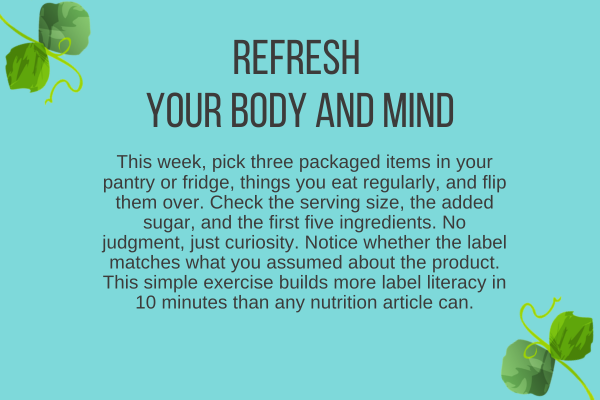
Start Here: The Serving Size
Before looking at any other number on the label, look at the serving size. And then check how many servings are in the package.
This is where labels trip most people up. A bag of chips might show 150 calories per serving, but if the serving size is 12 chips and the bag contains four servings, eating the whole bag means you’ve eaten 600 calories. This isn’t a trick to catch you out; it’s just information. But you can’t use the information correctly without checking this first.
The Three Numbers That Tell the Most Important Story
Once you’ve confirmed the serving size, these are the three areas to focus on:
• Total Sugar and Added Sugar. This is one of the most telling numbers on any label. Look specifically for “added sugars” – these are the sugars added during processing, separate from naturally occurring sugars in fruit or dairy. The American Heart Association recommends no more than 25 grams of added sugar per day for women. A single flavored yogurt, granola bar, or bottled dressing can easily hit half that.
• Protein. Especially relevant if you’re using a product as a meal or snack replacement. A “protein bar” that contains 6 grams of protein alongside 20 grams of added sugar is really just a candy bar in disguise. Look for at least 10–15 grams of protein in a snack you’re relying on to carry you.
• Fiber. Fiber slows digestion, stabilizes blood sugar, and feeds your gut microbiome. Most people get far less than the recommended 25+ grams per day. A product with 3 or more grams of fiber per serving is meaningfully contributing to your daily total.
The Ingredient List Is the Real Story
The nutrition facts panel tells you quantities. The ingredient list tells you quality. Ingredients are listed in descending order by weight, so whatever appears first is the most abundant in the product.
A few things to look for:
• If refined flour, sugar, or a syrup is in the first three ingredients of something marketed as “healthy,” take that as a signal to keep looking.
• Count the ingredients. A long, complicated list full of things you can’t pronounce is usually a sign of heavy processing, even if you’re tracking macros and the macros look acceptable.
• Watch for sugar under other names: dextrose, maltose, evaporated cane juice, brown rice syrup, agave nectar, and corn syrup are all still sugar.
• “Natural flavors” is a broad term that simply means the flavoring derived from a natural source – it tells you nothing specific about what’s in it or how much.
Marketing Claims to Take with a Grain of Salt
These terms are largely unregulated and designed to make a product seem healthier than it may be:
• “All Natural”: has no standard FDA definition and means almost nothing
• “Multigrain” or “Made with whole grains”: the product may contain mostly refined flour with only a small percentage of whole grain
• “Low fat”: fat was often replaced with sugar to compensate for lost flavor
• “Gluten-free”: many gluten-free products are more processed, not less, and can be higher in sugar and refined starches
None of this means these products are necessarily bad. It’s just that the front of the package is marketing, and the back is information. Go to the back.
The Supplement Label is a Whole Other Conversation
Everything above applies to food labels. But if you’re also trying to decode supplement labels (which is its own layer of complexity), quality and third-party testing matter far more than the numbers on the panel.
When it comes to supplements, label transparency is everything. For example, Shaklee’s Vitalizer is one of the most clinically studied supplement strips available, with over 80 nutrients in bioavailable forms, no artificial colors or preservatives, and a delivery system designed to release nutrients at the right time in digestion. When you can’t verify quality from a label alone, a brand with Shaklee’s research history and manufacturing standards does the vetting for you.
You don’t need to become a nutrition scientist to make better choices. You just need to know what to look for — and where food companies are likely to hide the things they’d rather you not notice.
Once you get comfortable reading labels, it becomes second nature. And your grocery cart starts to reflect what you actually want to eat, not just what was marketed most effectively. If you’d like more personalized guidance on building a way of eating that works for your body and your goals, I’m here to help. Reach out anytime.
