

If you’ve been feeling unusually tired, gaining weight without an obvious reason, losing hair, feeling cold when others aren’t, or experiencing a kind of mental fog that makes concentration feel like work – your thyroid may be worth a closer look.
Thyroid conditions are significantly more common in women than men, and the risk increases with age. By some estimates, one in five women over 40 has a thyroid issue and a substantial portion of those cases go undiagnosed or are dismissed because the symptoms overlap with so many other conditions, including perimenopause.
What Your Thyroid Actually Does
The thyroid is a small, butterfly-shaped gland at the base of your neck. Despite its size, it functions as the body’s master metabolic regulator, producing hormones (primarily T3 and T4) that control the rate at which virtually every cell in the body operates.
When thyroid output is optimal, energy, metabolism, mood, temperature regulation, digestion, and heart rate all function smoothly. When it underperforms (a condition called hypothyroidism) those systems slow down across the board. When it overperforms (hyperthyroidism), the opposite occurs: the body shifts into overdrive.
Hypothyroidism is by far the more common condition for women over 40, and it’s the one that most closely mimics the symptoms of perimenopause – which is precisely why it’s so frequently missed or attributed entirely to hormonal changes.
Symptoms That Often Point to the Thyroid
The classic signs of an underactive thyroid include:
- Persistent fatigue that doesn’t improve with sleep or rest
- Unexplained weight gain or difficulty losing weight despite consistent effort
- Hair thinning or shedding, often noticeable on the scalp and outer eyebrows
- Feeling cold, particularly in the hands and feet, even in warm environments
- Constipation or sluggish digestion
- Brain fog, slowed thinking, or difficulty with memory and concentration
- Dry skin, brittle nails, and a generally low-energy appearance
- Depression or low mood that feels disproportionate to circumstances
The challenge is that none of these symptoms is unique to thyroid dysfunction. They can all appear in perimenopause, iron deficiency, chronic fatigue, and several other conditions. A blood panel that includes TSH, Free T3, Free T4, and thyroid antibodies gives a much clearer picture than symptoms alone.
The Perimenopause Overlap and Why It Matters
Estrogen and thyroid hormones have a complex, bidirectional relationship. As estrogen fluctuates in perimenopause, it can affect how thyroid hormones are bound and transported in the bloodstream, making thyroid function appear normal on a standard TSH test even when symptoms are present.
This is one reason many women are told their thyroid is “fine” while continuing to feel anything but. Advocating for a more complete thyroid panel, and finding a practitioner willing to interpret results in the context of symptoms rather than numbers alone, can make a significant difference.
What Supports Thyroid Health Nutritionally
Several nutrients are directly involved in thyroid hormone production and conversion. When these are deficient, thyroid function suffers even when the gland itself is healthy:
- Iodine: the primary raw material for thyroid hormone synthesis. Found in seaweed, fish, dairy, and iodized salt. Most people in Western diets get adequate iodine, but those avoiding salt or dairy may fall short.
- Selenium: essential for converting T4 (the storage form of thyroid hormone) into T3 (the active form). Found in Brazil nuts, tuna, eggs, and sunflower seeds. Even a mild selenium deficiency can impair thyroid function.
- Zinc: supports thyroid hormone production and receptor sensitivity. Found in pumpkin seeds, legumes, meat, and shellfish.
- Iron: thyroid peroxidase, the enzyme required for thyroid hormone synthesis, is iron-dependent. Iron deficiency anemia is one of the most common nutritional contributors to hypothyroid symptoms in women.
- Vitamin D: low vitamin D is consistently associated with increased thyroid antibody levels and autoimmune thyroid disease. Optimizing vitamin D, particularly heading into fall and winter, is a good form of thyroid support.
Shaklee’s Vitalizer provides over 80 bio-optimized nutrients in a clinically studied daily strip including selenium, zinc, iodine, iron, and vitamin D in bioavailable forms that support thyroid function from the nutritional ground up. When your diet alone may not be closing every gap, a foundational supplement with Shaklee’s quality and research standards does the work consistently.
Lifestyle Factors That Affect Thyroid Function
- Chronic stress: elevated cortisol suppresses thyroid hormone conversion and reduces receptor sensitivity. Managing stress isn’t just good for your adrenals – it’s directly protective of thyroid function.
- Sleep deprivation: TSH follows a circadian rhythm, and disrupted sleep disrupts that rhythm. Consistent sleep quality is one of the most underappreciated forms of thyroid support.
- Excessive raw cruciferous vegetables: in very large amounts, raw goitrogenic foods like kale, broccoli, and cauliflower can mildly interfere with thyroid hormone production. Cooking neutralizes most of this effect, and moderate amounts of raw cruciferous vegetables are not a concern for most people.
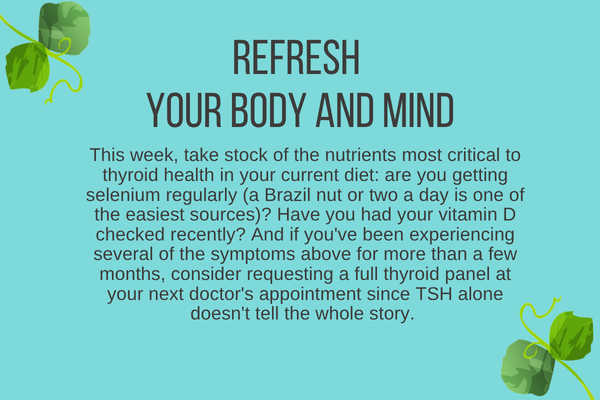
You deserve answers, not just “normal” results. Knowledge is the starting point for everything else. Thyroid health sits at the intersection of nutrition, hormones, stress, and sleep, which is exactly why it responds so well to an integrative approach.
If you’ve been chasing thyroid-like symptoms without clear answers, or want to be more proactive about supporting your thyroid as you move through midlife, I’d love to help you look at the full picture.
Reach out anytime to schedule a discovery session. Because the right support really does change how you feel.
