

Here’s something I often see in my practice…someone comes to me after taking probiotics, increasing their intake of fermented foods, and eliminating dairy, sugar, gluten, or all three. Yet despite these efforts, symptoms persist and they’re frustrated.
When working with someone with gut issues, the starting point isn’t usually about what to add or remove from their diet. The more useful exploration involves examining what’s happening in daily life that may not seem related to gut health but often is.
Here are four factors that frequently shift the conversation about digestive wellness, even when the refrigerator is already stocked with sauerkraut:
1. The pace at which meals are consumed, particularly lunch
Advising someone to chew slowly is straightforward, but actually eating an entire meal without doing anything else at the same time can feel surprisingly difficult – no scrolling, no answering messages, no catching up on work while standing at the counter. For many people, this level of stillness during eating feels almost uncomfortable.
Most people don’t rush meals because they’re careless about their health. They rush because a persistent low-grade urgency runs through their day, and it doesn’t switch off simply because they’ve sat down to eat.
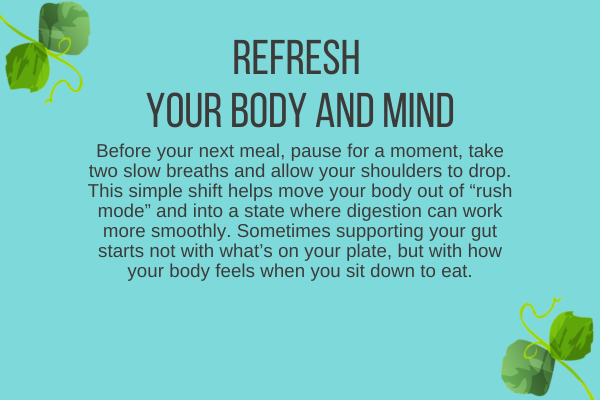
Helping someone become aware of what’s happening in their body before a meal, such as tight shoulders, shallow breathing, or the feeling of being slightly behind, often creates a bigger shift. Digestion doesn’t begin in the stomach. It begins when the body feels safe enough to pause and receive nourishment.
2. The type of fiber that actually works for their particular system
Fiber is widely promoted as universally beneficial, but not all fiber affects the gut the same way, and consuming more isn’t always better. Many people increase their fiber intake through raw vegetables, protein bars, or adding flax seeds to their smoothies. These are wonderful options but the most important thing is to pay attention to how your gut is responding to these additions.
Sometimes increased fiber leads to more bloating or to more frequent, but less satisfying, bowel movements.
Roasted root vegetables affect digestion differently than a raw kale salad. Cooked oats may be easier on the stomach than dry granola. The relevant question isn’t simply how much fiber is being consumed, but how the body responds to the forms of fiber it eats.
3. The relationship between sleep and digestion
Sleep and gut health are interconnected in ways that aren’t always straightforward. Poor sleep impacts digestion, but digestive discomfort can also interfere with the ability to fall asleep or stay asleep, creating a cycle that’s difficult to interrupt.
One useful inquiry is to identify when gut symptoms tend to flare most, whether during the day or overnight. For some people, discomfort remains a background issue during work hours but intensifies when lying down. For others, the problem isn’t stomach pain but rather waking early with a tense abdomen or a racing mind.
Sometimes an earlier dinner helps. Other times, adding something calming to the evening routine, such as a short walk or gently massaging the abdomen with warm castor oil before bed, provides more relief than any dietary change alone.
4. The emotional landscape surrounding food
I always ask my clients ‘What is your relationship to food?’ The body talks to us and often expresses this in various ways. It might show up as an intense awareness of every bite, or as guilt after meals that don’t feel sufficiently healthy. Many people experience decision fatigue when choosing what to eat, even when the available options are good choices.
This emotional background noise can keep the nervous system subtly activated, making digestion feel reactive rather than smooth. Some people notice that their stomach only tightens when they eat alone, or that they hold their breath while reading food labels. These are sensitive patterns to recognize, and there’s no quick fix for them. But simply naming what’s happening can create space for curiosity rather than constant vigilance.
Most of us intuitively understand that the gut is involved in more than just digestion, that it responds to environment, relationships, thought patterns and longstanding coping strategies. When these deeper layers receive attention alongside dietary choices, the changes that emerge tend to feel less like quick fixes and more like a gradual relearning of how to listen to what the body is communicating.
If you suffer from unexplained digestive issues, I’d love for you to join us for the 7-Day Gut Reset starting on April 6th. Contact me and I’ll send you the details.
