

It seems like a reasonable trade-off. You had a big dinner last night. You’re not all that hungry this morning. So you skip breakfast, maybe push lunch a little later, and tell yourself you’re being good.
But here’s what’s actually happening underneath that decision. And why it so often works against the very goals you’re trying to reach.
Your Body Hears “Famine,” Not “Discipline”
Your body doesn’t know you’re trying to eat less. It only knows that fuel hasn’t arrived when it expected it. And when that happens, especially consistently, it responds the way it has been wired to respond for thousands of years: it slows down.
Metabolism gets more conservative. The body holds onto stored energy more tightly. Cortisol (your primary stress hormone) rises to compensate for the perceived shortage. And the longer you go without eating, the more your blood sugar drops, setting off a cascade that makes the next food decision much harder to make well.
This isn’t a willpower failure. It’s physiology.
The Blood Sugar Rollercoaster
When you skip a meal, blood sugar drops gradually. At first, you might not notice much. But within a few hours, the brain (which runs almost entirely on glucose) starts sending increasingly urgent signals:
- Difficulty concentrating or thinking clearly
- Irritability or a short fuse (the origin of the word “hangry” is real)
- Fatigue and low motivation
- Intense cravings, usually for something sweet or starchy that will raise blood sugar fast
By the time you finally sit down to eat, you’re not making a calm, balanced choice – you’re in recovery mode. Portions get larger. Slower, more nourishing foods lose out to whatever is quick and available. And the blood sugar spike that follows sets up the next crash, often later that afternoon.
Skipping one meal doesn’t simplify your eating for the day. It tends to complicate the rest of it.
What Happens Over Time
Occasional meal-skipping is something the body handles well. But when it becomes a regular pattern, the effects accumulate:
• Muscle loss accelerates. When the body is in a prolonged energy deficit, it will break down muscle tissue for fuel, especially if protein intake is low. Less muscle means a slower metabolism, which is the opposite of what most people are hoping for.
• Cortisol stays chronically elevated. High cortisol promotes fat storage, particularly around the abdomen, and disrupts sleep, immune function, and hormonal balance. For women navigating perimenopause, this added cortisol load can worsen hot flashes, mood swings, and sleep disruption.
• Your relationship with food becomes more fraught. Cycles of restriction followed by overeating create a pattern of guilt, compensation, and restriction that becomes harder to break the longer it continues.
A Note on Intermittent Fasting
You might be thinking…but what about intermittent fasting? Isn’t that just strategic meal skipping? There’s an important distinction. Intentional, structured fasting is not the same as chaotic meal skipping. Intermittent fasting, done thoughtfully, involves a consistent eating window, adequate nutrition within that window, and ideally some professional guidance, particularly for women in perimenopause, whose hormonal systems are more sensitive to caloric restriction signals.
Skipping meals reactively because you’re busy, because you feel like you ate too much yesterday, or because you’re trying to compensate, rarely has the same structure or nutritional underpinning. And for many women, it makes hormonal balance harder, not easier.
What to Do Instead
The goal isn’t to eat more. It’s to eat more strategically. A few approaches that genuinely work:
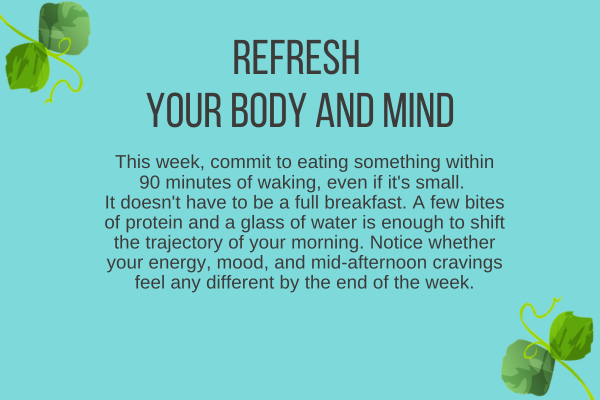
- Eat within an hour or two of waking. Even something small, like a hard-boiled egg, a handful of nuts, Greek yogurt sets your blood sugar on a stable path and tells your body that fuel is available and metabolism can stay active.
- Don’t let more than 4–5 hours pass between meals. This keeps blood sugar steady and prevents the desperate hunger that leads to poor choices. A small snack bridging a longer gap is often more helpful than skipping food entirely.
- Make protein the anchor of every meal. Protein is the most satiating macronutrient and the one most likely to keep you full and stable between meals. When protein is present, portion sizes naturally regulate themselves more easily.
- Plan for the gaps in advance. Busy days are inevitable. Having something portable and protein-rich on hand (such as almonds, a clean protein bar, cottage cheese, or a hard-boiled egg) removes the need to make a good decision when you’re already hungry and short on time.
The path to feeling better in your body is rarely about eating less. It’s about eating in a way your body can actually work with – consistent, balanced, and nourishing enough to keep your hormones, metabolism, and energy on an even keel.
If you’ve been caught in a cycle of skipping, overcompensating, and starting over again, know that there’s a gentler, more effective way through it. I’d love to help you find it. Reach out anytime to schedule a discovery session.
